Sunday, June 12, 2016

Composting Video


This blog entry is very short.  It's purpose is to give you a link to a video of our composting efforts that was shot by Ever Change Productions .  The video is part of a documentary on sustainability and opportunities to reduce, reuse and recycle waste here in Stillwater. 

Ever Change Productions rode with us on our weekly trip to pick up compost ingredients  from a fabulous little restaurant named Good Little Eater. These consist of vegetable peelings, egg shells, and so forth.  They are added to our compost pile which is then turned with a tractor.


Wednesday, June 8, 2016

Bee Flowers

Sigh!  So much to do.  So little time.  That's the story of our lives at this time of year.  The summer gardening season is in full swing.  Tom is busy from daylight to dark and, while I don't do a lot of the hard, labor-intensive work, there is always something to do.  As a result, I don't have a lot of time to spend on this blog.

I tend to take pictures with my phone as I go about my daily chores.  Then, at some point, I load them on my computer and ask myself, "Is there a blog in these somewhere?".

Today, as I was looking at the pictures I've taken, I realized there are lots of pictures of bees working over the flowers around the farm.  So, that's what you are going to see today!  Bees, bees and more bees.

I became enamored with the bees earlier this spring when the beekeeper came out and captured a swarm of bees from one of the hives.  I wrote about that in this blog entry:  
Bee Swarm .  Since then, I have taken a new interest in the bees and how they work together for the betterment of the entire hive.

Here is a bee on a kale plant that has begun to flower.  Normally, I would have pulled the kale up at this stage, but after seeing how much the bees liked it, I have left it for them.


And here's one on a blackberry flower.  I believe we are going to have a bumper crop of blackberries this year, partly due to the pollination the bees are providing.


We also have this beautiful Golden Rain Tree in our front yard.


The bees love the flowers.


They like the catmint planted in our front flower bed, too.  The catmint is in the lower right of the picture below.  There is some planted up the steps and in front of our porch, as well.


Here's a closeup of a bee working over the catmint.


I enjoy drinking coffee on the front porch in the mornings.  Needless to say, the audible hum coming from all the bees serves as nice background music as I savor the quiet coolness of the morning.

One of the early spring flowers that blooms in my flower bed is Thread-leaf Blue Star.  Here it is when it was blooming.


This plant provided a valuable source of food for the bees early in the spring when little else was available to them.


Another early-blooming plant that bees are attracted to is clover.  I even mowed around clumps of clover to give them another source of food when not much else was available to them.

I supposed I'm becoming a little eccentric in my old age.....well, maybe a LOT eccentric.  But, hey, I'm retired (from my day job) and I'm loving it!  

Wednesday, May 25, 2016

Garlic Scapes

I've written several posts about the garlic we grow, like  Garlic for the Garden   and   Time to Dig Garlic .  The second link contains a reference to "garlic scapes" which are the flower stalks the garlic bulb makes.  We cut these off so the plant will put all its energy into making a nice large head (root), instead of making a flower and producing seeds.

Depending on the variety of garlic, the scapes will be curly, like this.


Or, they will be long and straight, like this.


They actually make a rather pretty "bouquet".  Scapes have a mild garlic taste and are often used in cooking.  When cooking with them, the part closest to the flower bud is used because it is more tender.  The bottom part can be tough.  The stems can be sliced into small pieces and add to soups and stir-fries.   They can even be used in pesto.

This year, I am trying something new.  I heard scapes were very good when pickled.  So, I found a recipe online and did just that.  Here are the two jars of garlic scape pickles I made.


The one on the left was made from curly scapes and the one on the right from straight scapes.  These are refrigerator pickles.  The recipe I used called for vinegar, water, a little bit of sugar and salt.  These ingredients were brought to a boil and poured over the clean scapes in sterile jars.  The jars were then sealed, allowed to cool and stored in the refrigerator.   Other ingredients could have been added, as well, such as red pepper flakes, black pepper corns or mustard seed.

Never able to leave well enough alone, I wondered if scapes could be fermented.  Last fall, I wrote about my attempt at making kimchi, Making Kimchi .  In that article, I posted a picture of a cheap little fermenting set that I purchased online.  


The kimchi I made with it turned out great.  So, why not ferment garlic scapes?  Again, searching online (isn't the internet wonderful!), I found several references to fermenting garlic scapes.  So, here they are.....fermenting away.


Unfortunately, by the time I got around to doing this, I only had one small bunch of scapes left.  Tom had sold the rest of them to an Asian grocery store in town.  Apparently, garlic scapes are in high demand in oriental cuisine.  So, the jar is not full and they are just sort of floating around in the brine inside the jar.  

The jury is out on how the fermented ones will taste.  But, I can assure you the ones I pickled are excellent!


Wednesday, May 11, 2016

Apple Gourds

A couple of weeks ago I found some boxes of dried gourds out in the garage.  I can't remember when we grew them, but it has been several years ago.  So, one thing is certain, they last a long time once they are dried.  Unfortunately, rats or mice had gnawed into some of them to get the seeds.  But, I was able to salvage these.


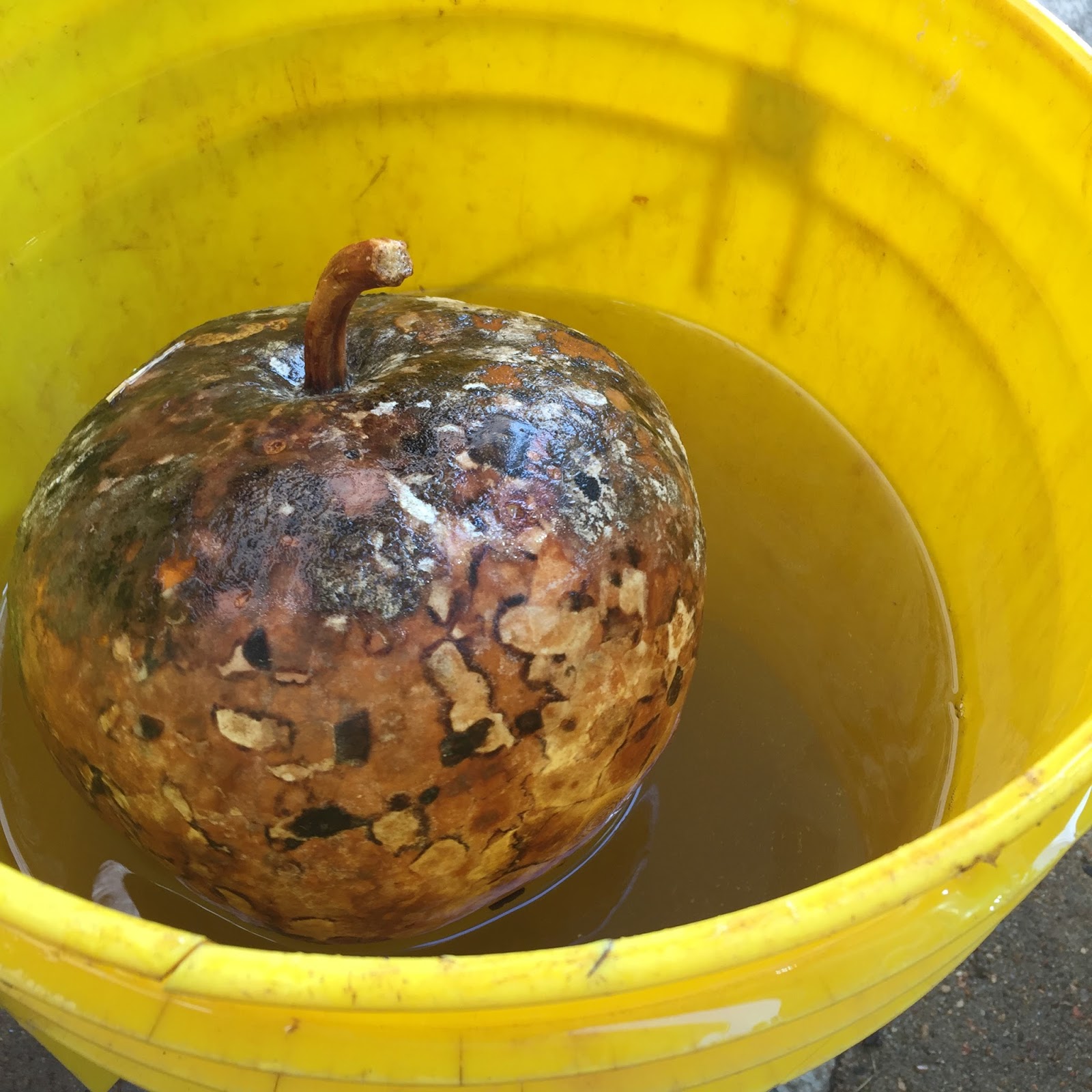
There are several kinds in the box, but most of them are Apple Gourds.  You can see how they very much resemble an apple in shape.  In fact, some folks (who are more artistic than I) make decorative items by painting them to look like apples.


Gourds have an outer coat that molds while they are drying.  Once dried, they have a dull, mottled appearance like the one above.  This coat has to be removed before a gourd can be painted.  Here's a picture to compare what they look like before and after the coat is removed.


The patterns on the gourd caused by the mold can be quite beautiful.  So, rather than painting them, I just leave them as is and enjoy the natural beauty of the gourd.  Here's how I remove the outer coat.

First, the gourds have to be soaked in water to soften that outer coat.  To do this, I use a 5-gallon bucket.  Two gourds will fit in a bucket.  The problem is ..... they float!


So, I have to weight them down to keep them submerged.  I use a large clay flower pot for this purpose.


Once the outer coat is softened, it can be removed easily.  I use a small kitchen knife and just scrape it off.  Here is a gourd that has been partially scrapped.


After scraping, I allow the gourd to dry thoroughly.  All kinds of things can be made from these gourds.  They are great for birdhouses and bowls.

Incidentally, this is what these apple gourds looked like when they were green.


They are quite heavy, as well, but very light when dry.  They grow on vines that get to be several feet in length.  Here's a blog entry I wrote in 2012 about some birdhouse gourds we grew.  It shows how long the vines get:  Birdhouse Gourds

We are not growing gourds this year.  We just don't have enough room.  However, for now, I have these nice Apple Gourds to work on and maybe next year we'll find room to grow some more.

Friday, April 22, 2016

Bee Swarm

Last summer, we were delighted when a friend of ours, who is a beekeeper, asked us if she could place some of her beehives on our land.  There are many insects that pollinate crops, but bees are exceptional pollinators.  So, we were really excited to have some bee hives on our land.


Most of the winter, the bees stayed in their hives.  But, on warm days we would see them out and about, looking for pollen.  Unfortunately, there was nothing for them to eat during the winter.  That all changed this spring when flowers started to appear and they became very active. 

Our beekeeper told us there was a possibility a couple of the more active hives might produce swarms.  This is where the hive produces a new queen and the old queen is forced out along with a good portion of the bees in the hive.  When this happens, they normally fly to a nearby resting place where most of the swarming bees stay with the queen while scouts are sent out to find a new home.

We were, therefore, not surprised when we found this in one of the peach trees a short distance from the hives.


It was an amazing sight and we immediately called the beekeeper.  Her first words were "Tell me you don't have a swarm!".  Ha!  Spring is a busy time for beekeepers as the hives come out of hibernation and become active.  At any rate, she came right over and prepared a small temporary hive in which to put the bees.


The hive is a small rectangular box.


Inside the box are frames containing wax cells to give the bees a starting point for their new home.


Once the new hive was prepared, it was time to put the bees in it.  Fortunately, the swarm was not very high off the ground and was within easy reach.  The bees were so distracted that she could touch the swarm without getting stung.  


She held the temporary hive under the swarm and gently shook the branch.


Most of the bees fell right into the box in one big blob.


She had to make sure the queen dropped into the box with the swarm.  As it turns out, there are ways to tell if the queen is in the box, other than actually seeing her.  The main way is to look and see if there are bees at the entrance to the hive fanning their wings with their bottoms pointed up, like this.


They are releasing a pheromone to tell the other bees that the queen is there.  Fanning their wings disperses the pheromone into the surrounding air.  

A few of the bees kept going back to the branch because some of the queen's scent was left behind.  The beekeeper used a brush to brush them into a container and "pour" them in the hive.


After she had captured as many as she could, she set another box on top of the first one and added a container of sugar water to it so the bees would have some nourishment to get them started in their new home.


Then she put a lid on top and bound the 2 boxes together with a strap.  She said it was best to leave the new hive in place for a couple of weeks to let the bees get settled.  Once they are settled in and she is sure they are not going to fly off to look for new quarters, then she will put them in a permanent hive, like the ones shown in the first picture.  


It has been such a fun experience having the bees on our farm.  I've been mowing around wildflowers and clumps of clover to give them more pollen sources.  And, once we have tomatoes, peppers, cucumbers, squash and other crops blooming, I know they will pay us back by pollinating those and boosting the amount of fruit and veggies we get.


Wednesday, April 13, 2016

Green Garlic

In February last year, I wrote a blog entry about the many different types of garlic that are available, Garlic for the Garden,  which includes a link with pictures of our 2014 garlic harvest.  

If you read that article, you will learn that we normally plant garlic in the fall and harvest it the following June.  This method gives you nice big heads of garlic that contain many cloves.  However, if you wait until the spring to plant some of your garlic, then you can have what I call "green garlic".  Green garlic is like green onions in that you dig it before it is ripe.  Here is what it looks like at this stage.


Notice it looks very much like a green onion.  But, the leaves of garlic are flat.

The leaves are too tough to eat, but the bottom part below the leaves can be sliced and sauteed to give a nice mild garlic flavor to whatever it is cooked with.


I like to saute green garlic with asparagus to make a tasty side dish.  Just slice the asparagus into 1 inch slices and throw it in a pan along with the sliced garlic and a tablespoon of olive oil.


I have a well-used wok that I use for this task.  Stir-fry it until the asparagus is crisp-tender.  Then, add salt and pepper to taste, and you have a vegetable dish that is to die for!


I didn't realize when I took this picture that the food in the upper right looks like pizza.  It's actually a piece of pork steak that was cooked in the oven along with rice, tomatoes, onions and peppers.  It just so happened that I cut the meat into smaller pieces and the piece I ended up with was triangular shaped.  

I don't know why I felt compelled to clarify that point, except that I'm not a big pizza fan, and the thought of eating rice, pizza and asparagus is, well, just disgusting to me!

Monday, April 4, 2016

Dandelion Fritters

Do you have any of these in your yard?  


If you do, I hope you are not wringing your hands and gnashing your teeth because of them!  In fact, dandelions are very nutritious and all parts of the plant are useful.  The leaves are full of nutrition and can be sauteed or used raw in salads.  In the old days, folks would make spring tonics from dandelions.  These tonics supplied much needed vitamins that were missing from their winter diets. 

Dandelions have thick deep roots from which the plants come up year after year.  


The roots can be roasted, ground and stored in an air-tight container to later be used as a hot beverage when mixed with boiling water. The roasted roots are supposed to taste a bit like coffee and chocolate.  I plan to dig some of them and give this a try.

One thing I have tried this spring are dandelion "fritters".  Tom was skeptical about these, but ended up trying them and said they weren't bad.  Ha!  That is a big thumbs up being that he is not the most adventurous soul when trying new things.

Here's how I made them.  First, I picked flowers that had longish stems.


Then I made a batter of milk, eggs and flour and used the stems to dip the flowers in the batter.


Next, it was just a matter of placing the batter-dipped flowers into hot oil and frying them until they were browned.  


Once they were drained on paper towels and slightly cool, we ate them like Popsicles by holding the stems and biting off the flowers.  

I've been reading about making dandelion wine, as well.  The flowers are used to make wine, but the recipe I saw called for a gallon of dandelion flower petals.  The stems and core would have to be removed.  It seems to me this would take a LONG time and I'm not sure my poor back would tolerate bending over long enough to pick that many flowers!  So, I think I'll leave the dandelion wine to someone with a stronger back and more patience.